

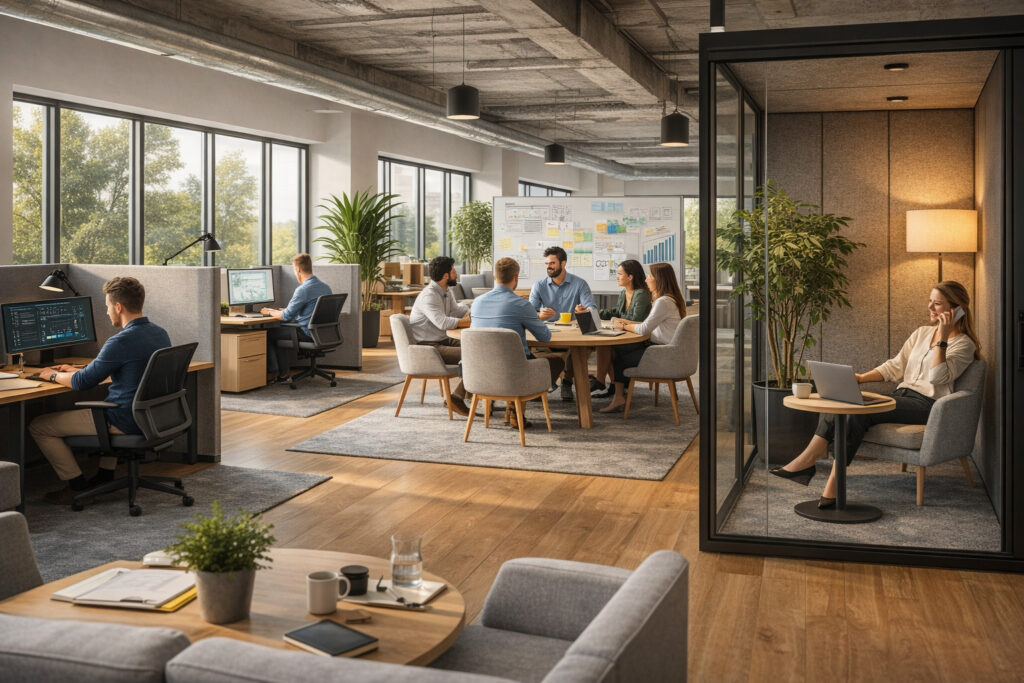
The modern workplace is no longer built around a single way of working. Employees are no longer confined to one task, one environment, or one type of interaction. Instead, the modern office must support multiple work styles—each with its own needs, challenges, and environmental requirements.
From deep focus work to team collaboration and constant virtual meetings, today’s workforce requires a dynamic environment that adapts to how people actually work. Companies that fail to design for these differences often experience reduced productivity, increased distractions, and frustrated employees.
This article explores how to design office spaces that support three core work styles: deep work, collaboration, and calls.
Why Work Style-Based Design Matters
Traditional office layouts assumed that all employees worked the same way. Rows of desks, uniform layouts, and minimal differentiation between spaces were the norm. However, this approach no longer aligns with modern work patterns.
Employees now shift between tasks throughout the day—writing reports, attending meetings, brainstorming ideas, and taking calls. Each activity requires a different environment. Designing a workspace that supports these transitions improves efficiency, reduces frustration, and enhances overall performance.
Understanding the Three Core Work Styles
Deep Work: Focus and Concentration
Deep work involves tasks that require sustained focus, critical thinking, and minimal interruption. Examples include data analysis, writing, coding, and strategic planning.
For deep work, distractions are the biggest enemy. Noise, movement, and interruptions can significantly reduce productivity.
Collaboration: Team Interaction and Creativity
Collaboration involves teamwork, idea sharing, and problem-solving. These activities benefit from open spaces, flexible seating, and accessible tools.
Unlike deep work, collaboration thrives in environments that encourage interaction and communication.
Calls: Virtual Communication
With hybrid work becoming standard, calls have become a major part of daily operations. Employees frequently participate in video meetings, client calls, and internal check-ins.
Calls require privacy, sound control, and professional backgrounds.
Designing Spaces for Deep Work
To support deep work, offices must provide quiet zones where employees can focus without interruption.
- Private workstations or enclosed offices
- Acoustic panels or soundproofing materials
- Minimal visual distractions
- Ergonomic furniture for extended focus sessions
These spaces should be clearly designated as quiet zones to prevent interruptions.
Designing Spaces for Collaboration
Collaborative spaces should encourage interaction while remaining functional.
- Open seating arrangements
- Whiteboards and shared tools
- Flexible furniture that can be rearranged
- Comfortable seating for longer discussions
These areas should be easily accessible and positioned away from quiet zones.
Designing Spaces for Calls
Call spaces are essential in modern offices.
- Phone booths or small private rooms
- Soundproofing for confidentiality
- Proper lighting for video calls
- Neutral backgrounds for professionalism
Providing dedicated call areas reduces noise in open spaces and improves communication quality.
Balancing All Three Work Styles
The most effective offices don’t prioritize one work style over another. Instead, they create a balance that allows employees to move between spaces as needed.
This flexibility ensures that employees can choose the environment that best supports their current task.
Final Thoughts
Designing for different work styles is no longer optional—it’s essential. By creating spaces for deep work, collaboration, and calls, companies can build environments that support productivity, adaptability, and long-term success.