

Modern office design has spent years moving toward open layouts. Open offices were created to improve collaboration, communication, and transparency. But as many companies have discovered, too much openness comes with a cost: distractions, lack of privacy, and reduced productivity.
The challenge today is not choosing between open or private offices — it’s finding the right balance. The solution lies in strategic furniture choices that create privacy without sacrificing openness.
The Problem With Fully Open Offices
Open offices were designed with good intentions. They aimed to break down barriers, encourage teamwork, and create a more connected workplace. However, over time, companies began to notice unintended consequences.
Employees struggled with constant noise, lack of focus, and limited ability to handle private conversations. Tasks that required concentration became harder to complete. Calls became disruptive. And employees often felt like they were always being watched.
This doesn’t mean open offices are flawed—it means they need to evolve.
Why Privacy Matters in the Workplace
Privacy is not about isolation. It’s about control. Employees perform better when they can choose when to collaborate and when to focus.
Privacy supports:
- Deep work and concentration
- Confidential conversations
- Reduced stress and cognitive overload
- Improved job satisfaction
Without privacy, even the most well-designed office can become a source of frustration.
Furniture Solutions That Balance Privacy and Openness
1. Panel-Based Workstations
Panel systems provide visual and acoustic separation without fully closing off employees. Mid-height panels allow employees to focus while still maintaining a sense of openness.
2. Acoustic Pods and Phone Booths
Dedicated spaces for calls and private conversations are essential. These small, enclosed areas reduce noise in the main workspace and provide employees with a place to focus.
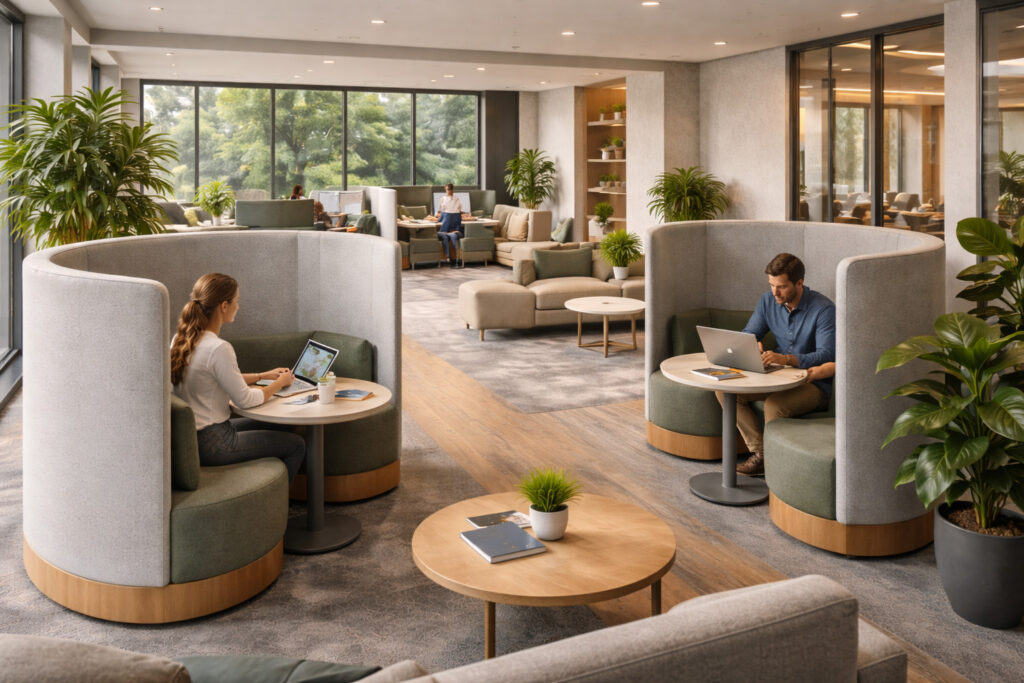
3. Lounge Seating with Partial Enclosures
High-back lounge seating creates semi-private zones for informal meetings or focused work.
4. Strategic Furniture Placement
Positioning furniture to create natural barriers—such as bookshelves, storage units, or partitions—can define spaces without fully enclosing them.
Designing for Choice
The most effective offices give employees options. Instead of forcing everyone into one type of environment, businesses should create a variety of spaces.
Employees should be able to move between:
- Open collaborative areas
- Quiet focus zones
- Private call spaces
This flexibility allows individuals to choose the environment that best supports their task.
Final Thoughts
Privacy and openness are not opposites—they are complementary. The right furniture strategy creates a balanced environment where employees can collaborate when needed and focus when necessary.
Companies that understand this balance create workspaces that support both productivity and well-being.